
The right pallet for your supply chain
If you’d like to read more interesting articles about road transport, sign up to receive our logistics newsletter and get regular updates on all the latest from the industry!
Common types of pallets
According to Wikipedia, a ‘pallet’ is a ‘flat transport structure, which supports goods in a stable fashion while being lifted by a forklift, a pallet jack, a front loader, a jacking device or an erect crane. A pallet is the structural foundation of a unit load, which allows handling and storage efficiencies.’ That being said, pallets can be classified using various criteria, such as by material, shape, size or application. In this article, we give you a quick overview of the most common types of pallets.
Wooden pallets
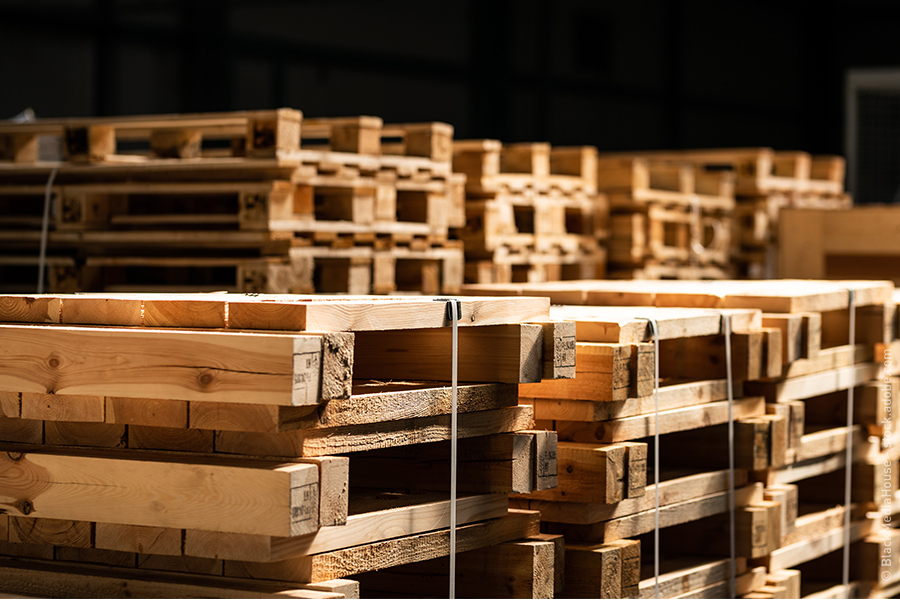
Wooden pallets are one of the most common types of pallets. Rules on the treatment of the wood are in place to prevent pathogens being imported, including heating the wood to certain temperatures to denature the proteins in it. While basically any type of wood can be used to produce pallets in theory, only 17 have been approved for this purpose, including maple, birch, oak, pine and elm.
When it comes to wooden pallets, most people think of Euro-pallets (also known as EUR-pallets or Europool pallets). The Euro-pallet is very common in Europe and is used especially frequently to transport consumer goods, such as deliveries to supermarkets, for example. The EN 13698 standard for the Euro-pallet specifies that its dimensions must be 1,200 mm x 800 mm x 144 mm. It can be lifted and transported from all four sides and covers 0.4 loading metres.
One of the big advantages of working with Europool-pallets is that – as the name suggests – they can be exchanged via the pallet pool system. We have previously looked at how exchanging pallets works and shared a few helpful tips from the experts on this topic in another one of our blog posts.
But the Euro-pallet isn’t the only type of pallet made of wood. There’s also the CP pallet, for example, which was specially developed for a number of sectors, such as the food and chemicals industry. One wooden pallet that’s a bit different to others of its type is the INKA pallet, which is made of compressed wood and can be nested one inside the other when empty to save space.
Plastic pallets
Pallets made of plastic are a popular alternative to wooden pallets and are typically used as either disposable or reusable pallets. Disposable plastic pallets are made of materials such as polypropylene (PP) or polyethylene (PE), making them lightweight while still featuring a high load carrying capacity. These pallets can be recycled after transport, and one of their advantages is that they do not have to be treated against moisture or pests.
Reusable plastic pallets are made of sturdy plastic, so they are long-lasting, shock resistant and robust. They are used especially often in closed-loop supply chains, where they can be returned and used again once they have been unloaded.
Hygiene pallets come into play in sectors with particularly stringent hygiene regulations, such as the pharma or food industry, and are produced specifically for this purpose. They are usually easy to clean and resistant against chemicals. The aim in using this type of pallet is to minimise the risk of contamination.
Metal pallets
Metal pallets are primarily selected due to their durability and robustness during transport. Steel pallets, for example, are often used in industrial environments such as mechanical engineering or metal processing, where they can be exposed to mechanical and chemical stresses.
Aluminium pallets, on the other hand, are particularly lightweight and resistant to corrosion, making them suitable for use in areas where ease of handling is an advantage. Aluminium pallets also come into play in the food industry as they are hygienic and not affected by rust.
Similar advantages can be achieved with stainless steel pallets, which are also particularly resistant to corrosion and thus suitable for use in areas where hygiene and cleanliness are important.
Special pallets
Various types of special pallets are also used in road transport and have been specially developed for certain requirements or sectors. Among others, these include flat pallets, which do not have a frame around the edge and consist solely of a flat surface. These pallets often have holes in them, making them lighter and improving ventilation. They are typically used in sectors such as agriculture and the building materials industry or for storing large, bulky goods. In addition to flat pallets, there are other special pallets that used specifically for transporting hazardous substances or sensitive goods, for example. Some companies also produce special pallets to meet your individual requirements.
Criteria for selecting the right pallet
Selecting the right type of pallet depends on a range of factors, including the type of goods being transported, the requirements in the supply chain, the storage environment and other specific needs. Here are a few questions to help you find the right type of pallet:
- What goods do you want to transport? Think about the type, weight and size of the goods as well as how sensitive they are. Heavy or sensitive goods might require robust or special types of pallets to ensure they can be transported safely.
- What is your supply chain like? Look at the different steps in the supply chain, such as loading, transport and unloading and think about the requirements they involve. For example, you should consider whether the pallets are stackable or have to be transported with a forklift.
- What environmental factors have to be taken into account? Think about the influences that the pallets will be exposed to during transport, such as whether they will get wet or could come into contact with chemical substances.
- Are there any special requirements? Check whether there are special requirements that need to be followed, such as hygiene rules or security regulations, for example.
- Does the pallet offer good value for money? Your choice should make sense from a business perspective as well as being functional. Take into account aspects such as the purchase price, reusability, durability and transport efficiency.
You might also find it helpful to speak with specialists or companies providing pallets to address specific questions and get recommendations based on your requirements. A careful analysis of the above factors will help you select the right type of pallet that meets the requirements in your supply chain to best effect.
The right pallet type for a safe and efficient supply chain
The right type of pallet is key to ensuring a safe and efficient supply chain. You’ll need to take into account various criteria depending on the type of goods being transported, the requirements in the supply chain, environmental factors and specific requirements. Wooden pallets, plastic pallets, metal pallets and special pallets – they all offer their own advantages and potential uses. Carrying out a careful analysis of these factors and getting advice from specialists where necessary can help you select the right type of pallet that best meets your requirements. Using suitable pallets will let you simplify the process of handling goods, make best use of the space available and ensure your supply chain runs smoothly.
Want to take your knowledge of logistics and road transport to the next level? Sign up for our logistics newsletter and stay up to date!
You may also be interested in:
Digitalisation in the transport and logistics industry